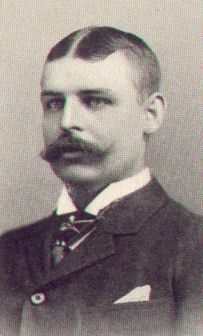
| Commander John Bell Blish
|
| Generation: | 8 |
| Born: | September 8th, 1860 |
| Birthplace | Seymour, Indiana, USA |
| Died: | December 22nd, 1921, at about age 61 |
| Burial: | Arlington cemetery, Washington, District of Columbia, USA |
| Father: | John Hedding Blish |
| Mother: | Sarah (Shields) Blish |
| Occupation(s): | Naval officer, Base Commander, Inventor |
| Marriages: | None known |
| Children: | None known |
   InventionsThe Blish Sounding TubeThis is a pipe, or tube, used for measuring the depth of water. That's all I know about it at this point. More to come, hopefully. CBB/March/2001 The Blish LockIn 1915 he patented a delayed blowback breech system in which a sloping metal wedge interlocked the breech block with the gun body. Under high pressure, as when the cartridge fired, the angle of the slope was such that the mating faces jammed solid. As the pressure dropped, the faces were able to slip across each other, the wedge moved up due to the slope, and the breech unlocked. Brigadier General John Taliaferro Thompson (ret.), after investigating John Blish's invention, offered him shares in a company he was forming in exchange for the patent. John Blish accepted and with the financial backing of Thomas Ryan, the Auto-Ordnance Company was founded in 1916. This company then produced the Thompson submachine gun. The Blish PrismFrom "A History of Nautical Astronomy" by Charles H. Cotter (Hollis & Carter, 1967): "To eliminate the uncertainty of the effect of refraction on the dip of the sea horizon, Commander Blish of the United States Navy invented, in the early part of the 20th century, an attachment for a sextant known as the Blish prism. This device has the top and bottom faces beveled at 45 degrees. It is fitted to the sextant so that the longer of the front and back surfaces faces the observer. This face is provided with two polished surfaces, the lower of which is directly opposite the top of the index mirror, and the higher of which faces over the observer's head towards that part of the horizon 180 degrees away from the part the observer is facing. With the index of the sextant set to zero on the arc the observer looks directly at the sea horizon in front of him and sees, at the same time, the back horizon reflecting from the prism. When the fore and back horizons are brought into line, the sextant reading is twice the angle of dip, assuming that the sextant is free from index error." 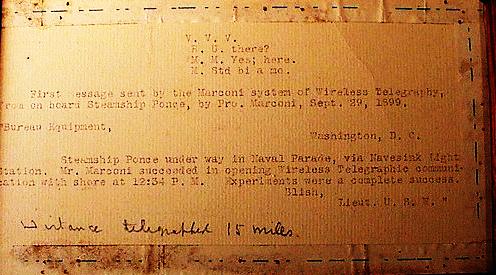 John Blish makes Radio HistoryOn September 28th, 1899, Lieutenant John Blish sent the following from the S. S. Ponce to the Navesink, New Jersey shore station (a lighthouse):
The above message is considered to be the first paid ship-to-shore radiogram, as well as the first official U.S. Naval radio message. Lieutenant John Blish was an official US Naval observer assigned to report on the Marconi demonstrations. John Blish died in 1921. The US Navy posthumously named a small warship in his honor, the USS John Blish. |
Commander John Bell Blish1860 through 1921
|